How to Choose a Planetary Gearbox for Servo Motors
Choosing the right planetary gearbox for a servo motor is not only about matching a ratio. Engineers also need to consider torque, backlash, mounting space, shaft connection, duty cycle and the real motion condition of the machine.
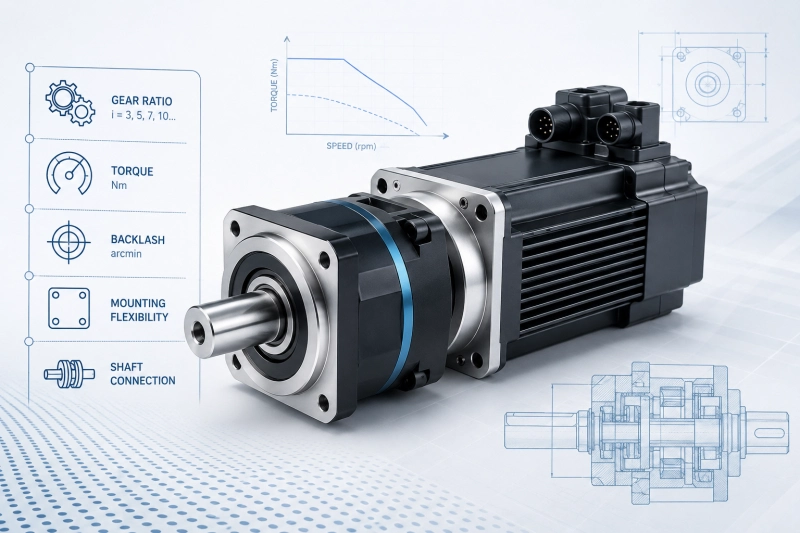
Planetary gearbox selection starts from the motor, load, speed, torque and installation layout.
A servo motor can provide fast response, accurate control and stable speed regulation, but in many machines the motor cannot drive the load directly. The motor speed may be too high, the available torque may be too low, or the installation space may require a more compact transmission structure. In these cases, a planetary gearbox is commonly used between the servo motor and the driven mechanism.
A well-selected planetary gearbox helps reduce motor speed, increase output torque, improve load matching and make the whole motion system easier to control. A poor selection, however, may cause vibration, overheating, positioning error, noise, short service life or mechanical damage. This guide explains how to choose a planetary gearbox for servo motor applications from a practical engineering perspective.
To choose a planetary gearbox for a servo motor, start with the required output speed and gear ratio, then check output torque, acceleration torque, radial load, axial load, backlash, mounting direction, shaft type and motor flange compatibility. For compact same-axis layouts, choose an inline planetary gearbox. For space-saving 90-degree layouts, choose a right angle planetary gearbox. For precision positioning, choose a low backlash planetary reducer.
1. Start with the Machine, Not Only the Motor
Many selection mistakes happen because the gearbox is chosen only according to the servo motor power. In real equipment design, the gearbox should be selected according to the machine condition first. The motor is important, but the load side determines the actual demand.
Before choosing a planetary gearbox, confirm what the machine needs to move. Is it a ball screw, belt conveyor, rotary indexing table, packaging mechanism, robotic axis, lifting system or linear module? Different loads create different requirements for torque, inertia matching, rigidity and backlash.
For example, a light conveyor may need stable speed and moderate torque, while a CNC feeding mechanism may require lower backlash and higher positioning accuracy. A rotary fixture may need strong output bearing capacity, while a compact packaging machine may need a right angle layout to save installation space.
Information to Prepare Before Inquiry
Motor brand and model
Required output speed or ratio
Load torque and acceleration condition
Required backlash or positioning accuracy
Mounting space and direction
Output shaft, flange or drawing requirements
2. Calculate the Gear Ratio from Output Speed
Gear ratio is usually the first technical parameter to confirm. The basic logic is simple: the servo motor speed is reduced by the gearbox ratio, and the output torque increases according to the ratio and gearbox efficiency.
Basic formula:
Gear Ratio = Motor Speed ÷ Required Output Speed
If a servo motor runs at 3000 rpm and the machine requires 300 rpm at the output, the required ratio is about 10:1. If the output speed should be 100 rpm, the ratio may be about 30:1. In practical selection, standard ratios such as 3, 5, 7, 10, 15, 20, 30, 50 or 100 may be considered depending on the gearbox series.
A higher ratio can provide more torque, but it also reduces output speed and may affect dynamic response. For servo systems that require frequent acceleration and deceleration, the ratio should be selected together with inertia matching and torque reserve, not only by speed reduction.
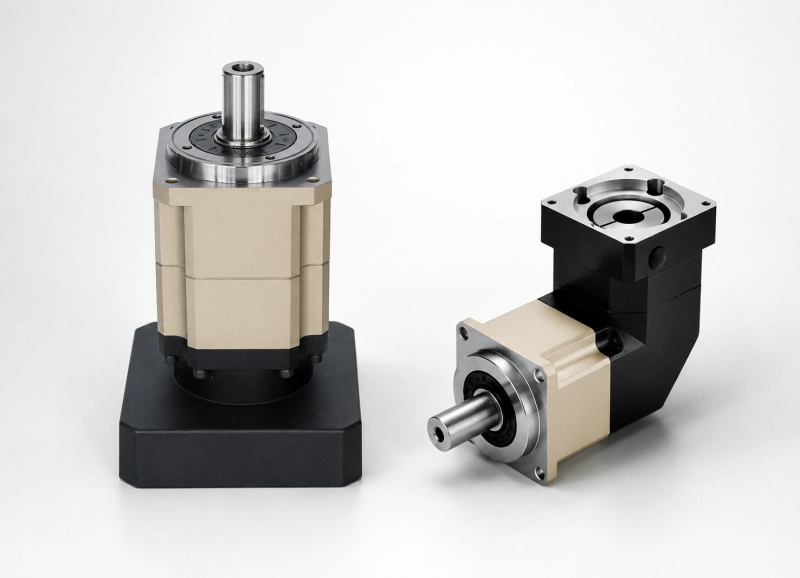
3. Choose Inline or Right Angle Layout
The gearbox layout should match the mechanical structure of the equipment. For many servo motor applications, the two most common layouts are inline planetary gearbox and right angle planetary gearbox.
An inline planetary gearbox keeps the motor shaft and output shaft on the same centerline. This design is suitable for compact same-axis transmission, linear motion modules, CNC machinery, automation slides and servo-driven equipment where straight power transmission is preferred.
A right angle planetary gearbox changes the transmission direction by 90 degrees. It is useful when the motor cannot be installed in line with the load, or when the machine needs a shorter overall length. Packaging machines, rotary mechanisms and compact automation units often use right angle layouts.
If space is enough and simple installation is preferred, inline type is often the first choice. If the equipment layout is limited or the motor must be mounted from the side, right angle type may be more practical.
4. Check Rated Torque and Peak Torque
Torque is one of the most important parameters in planetary gearbox selection. The gearbox must handle the continuous running torque of the machine and also the short-time peak torque during acceleration, deceleration, start-stop movement or impact loading.
In servo motor systems, peak torque can be much higher than rated torque. If the gearbox is selected only according to rated motor power, it may be overloaded during dynamic operation. For machines with frequent start-stop cycles, the acceleration torque should be carefully checked.
Rated Torque
Continuous torque during normal running.
Peak Torque
Short-time torque during acceleration or impact.
Safety Margin
Reserve capacity for unstable load conditions.
For reliable selection, provide the motor torque, load condition and motion cycle when requesting a quotation. If the load is heavy, the speed changes frequently or the equipment operates for long hours, a stronger gearbox size may be required.
5. Select Backlash According to Positioning Accuracy
Backlash refers to the angular clearance between gear teeth. For simple speed reduction applications, standard backlash may be acceptable. But for servo positioning systems, especially equipment with reversing motion, small angular movement or repeated positioning, backlash becomes much more important.
A low backlash planetary reducer is usually selected when the machine requires more accurate motion response, better repeatability and stable output under frequent direction changes.
Typical applications include CNC machinery, precision feeding systems, robotic axes, inspection equipment, indexing devices and automation equipment where position error must be controlled.
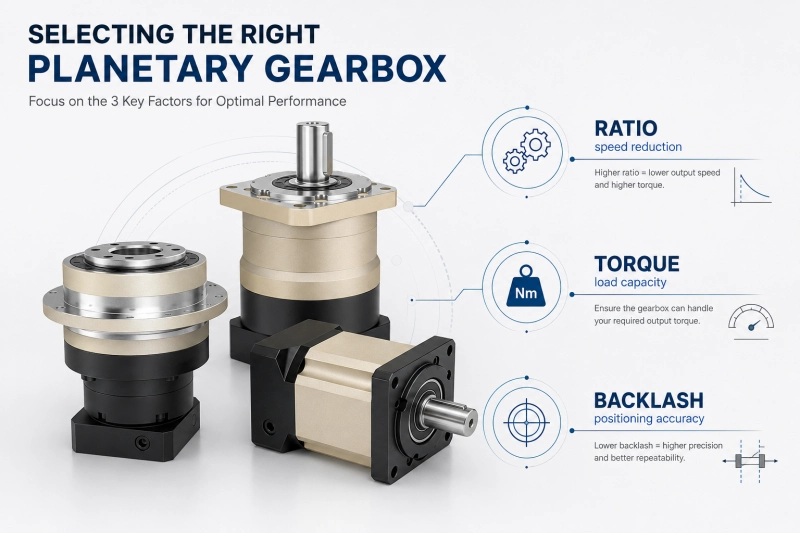
6. Confirm Motor Flange, Input Bore and Output Shaft
Even if the gearbox ratio and torque are correct, the gearbox still needs to physically match the servo motor and machine interface. Motor flange size, input shaft diameter, keyway, output shaft type and mounting holes should all be confirmed before ordering.
A common selection process is to provide the servo motor model first. With the motor model, the gearbox supplier can check the motor flange, input bore, adapter plate and shaft coupling requirement. If the machine side has a special output shaft, flange or mounting direction, a drawing is helpful.
Key Interface Information
Servo motor brand and model number
Motor shaft diameter and length
Motor flange size and bolt pattern
Required output shaft type
Machine-side mounting drawing if available
For OEM projects, standard and modified interface options may be considered. This is useful when the equipment has limited installation space or when the gearbox needs to match an existing machine design.
7. Match the Gearbox Type to the Application
Inline Planetary Gearbox
Suitable for same-axis servo transmission, compact linear motion equipment, CNC machinery and automation mechanisms.
View Inline Gearbox →Right Angle Planetary Gearbox
Suitable for 90-degree transmission layouts, compact equipment, packaging machines and side-mounted servo motor designs.
View Right Angle Gearbox →Low Backlash Planetary Reducer
Suitable for precision positioning, frequent reversing motion, robotic axes and higher repeatability requirements.
View Low Backlash Reducer →8. Common Selection Mistakes to Avoid
One common mistake is choosing the gearbox only by motor power. A 400W servo motor may be used in many different machine conditions, but the required gearbox size can be very different depending on the load, speed, acceleration and installation method.
Another mistake is ignoring backlash. If the application requires precise positioning, a standard gearbox may not provide the required repeatability. For servo systems that reverse direction frequently, backlash should be considered early in the design.
A third mistake is selecting a ratio without checking output speed. A high ratio may increase torque, but it may also make the output too slow. A low ratio may provide speed, but the torque reserve may be insufficient. Ratio, torque and speed must be checked together.
The last mistake is ignoring installation space. If the motor and gearbox are too long for the machine frame, the design may require a right angle planetary gearbox instead of an inline type.
Related Technical Resources
If you are comparing reducer options for servo motor positioning, automation equipment, or precision motion systems, the following product resources may help with model selection and structure comparison.
- PlanetDrivePro planetary gearbox series — overview of inline and right angle planetary gearbox options for automation applications.
- Inline planetary gearbox — suitable for compact coaxial servo motor transmission layouts.
- Contact Zhuochuang for gearbox selection support — useful when torque, ratio, backlash, flange size, and motor matching need to be checked together.
FAQ: Planetary Gearbox for Servo Motor
Why use a planetary gearbox with a servo motor?
A planetary gearbox reduces servo motor speed, increases output torque, improves load matching and helps the motor drive the machine more efficiently.
Is an inline planetary gearbox better than a right angle gearbox?
Neither type is always better. Inline gearboxes are suitable for same-axis layouts, while right angle gearboxes are better for 90-degree transmission and space-limited machine designs.
When should I choose a low backlash planetary reducer?
Choose a low backlash planetary reducer when the machine requires precise positioning, frequent reversing motion, stable repeatability or better servo response.
What information should I send for gearbox selection?
Send the motor model, required ratio, torque demand, load condition, backlash requirement, output shaft type, mounting space and any available installation drawing.
Need Help Choosing a Planetary Gearbox for Your Servo Motor?
Send your servo motor model, required ratio, torque, backlash requirement and installation drawing. We will help check a suitable planetary gearbox configuration for your equipment.