Inline vs Right Angle Planetary Gearbox: Which One Should You Choose?
Inline and right angle planetary gearboxes can both work with servo motors and stepper motors, but they solve different machine layout problems. The right choice depends on shaft direction, installation space, transmission path, load position and maintenance access.
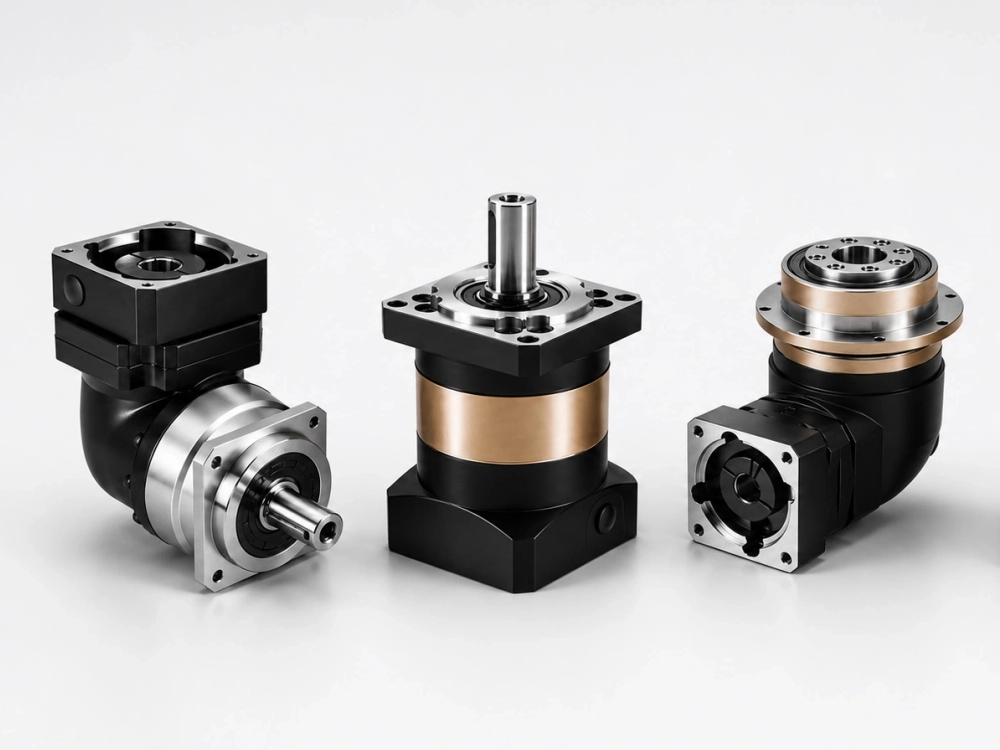
Inline gearboxes keep the same shaft direction, while right angle gearboxes change the transmission direction by 90 degrees.
When engineers choose a planetary gearbox for a motion system, the first question is often ratio, torque or backlash. These parameters are important, but the gearbox layout should be considered just as early. If the motor position conflicts with the machine frame, conveyor direction, rotary mechanism or maintenance space, the wrong gearbox layout can make the entire design difficult to install.
The two common layouts are inline planetary gearbox and right angle planetary gearbox. An inline planetary gearbox keeps the motor input and gearbox output on the same axis. A right angle planetary gearbox changes the direction of transmission, usually by 90 degrees, so the motor can be mounted from the side. This article compares both types from a practical equipment design perspective.
Choose an inline planetary gearbox when the servo motor and output shaft can stay on the same centerline and the machine has enough axial space. Choose a right angle planetary gearbox when installation length is limited, when the motor must be mounted from the side, or when the machine requires a 90-degree transmission path. For precision positioning, both layouts can be selected with low backlash specifications.
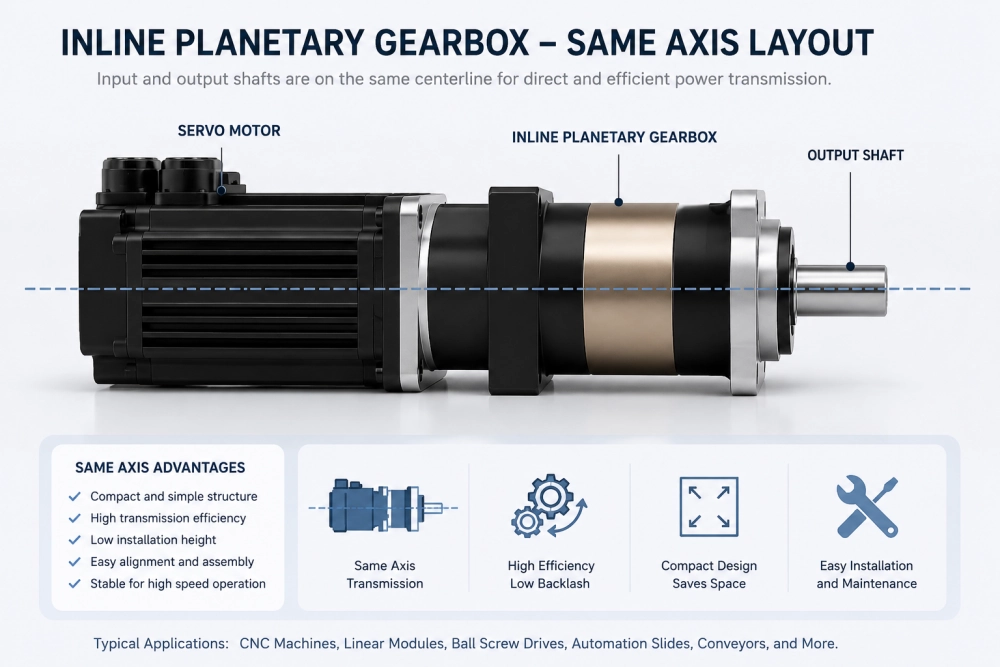
For applications where the motor and output shaft can stay in the same direction, an inline planetary gearbox is often the simplest and most compact choice.1. What Is an Inline Planetary Gearbox?
An inline planetary gearbox is designed with the input shaft and output shaft arranged on the same centerline. The servo motor connects to one side of the gearbox, and the output shaft drives the load directly in the same direction.
This layout is simple, compact in diameter and easy to understand during machine design. It is commonly used in linear modules, ball screw drives, belt drive systems, CNC machinery, automation slides, cutting equipment and servo-driven positioning mechanisms.
Inline type is often selected when the machine has enough length for the motor and gearbox assembly. It is also suitable when the designer wants a straight transmission path with fewer direction changes.
2. What Is a Right Angle Planetary Gearbox?
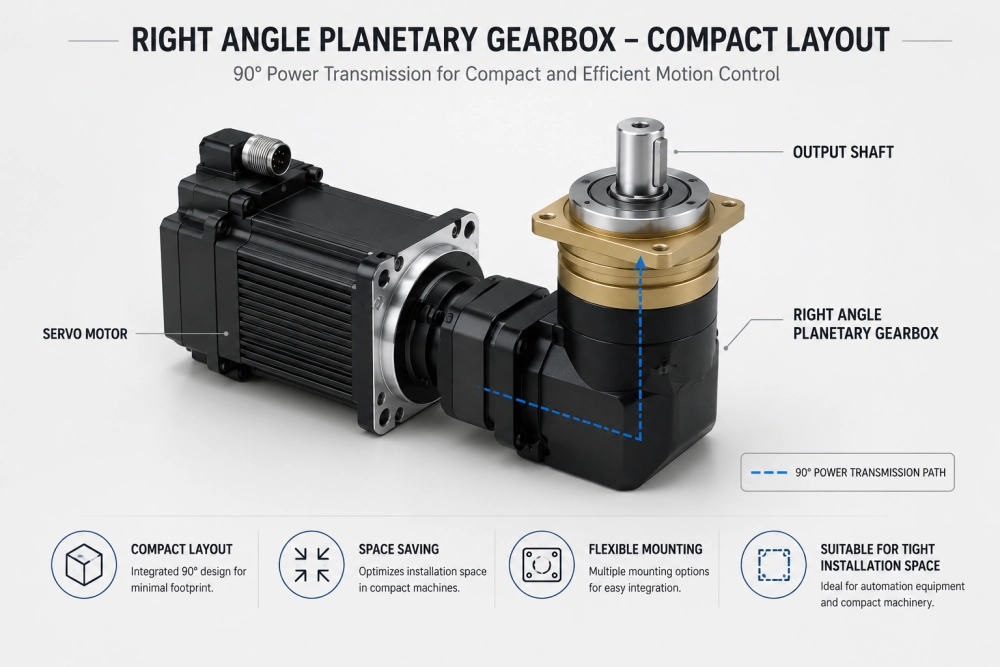
A right angle planetary gearbox changes the power transmission direction by 90 degrees. The motor is mounted perpendicular to the output direction, which helps reduce the total machine length and makes the layout more flexible.
Right angle designs are often used when the motor cannot be installed behind the driven shaft. This can happen in packaging machines, rotary mechanisms, compact automation stations, side-mounted conveyor systems, vertical lifting units and equipment with limited rear space.
For many machine builders, the main reason to choose a right angle planetary gearbox is not only torque transmission. It is the ability to place the motor in a better position without changing the machine function.
3. Key Differences Between Inline and Right Angle Planetary Gearboxes
| Selection Factor | Inline Planetary Gearbox | Right Angle Planetary Gearbox |
|---|---|---|
| Transmission Direction | Input and output remain on the same axis. | Transmission direction changes by 90 degrees. |
| Installation Space | Needs more axial length behind the load. | Helps shorten the overall machine length. |
| Machine Layout | Best for straight-line power transmission. | Best for side-mounted motor arrangements. |
| Typical Use | Linear modules, CNC axes, belt drives and ball screw systems. | Packaging equipment, rotary mechanisms and compact automation stations. |
| Design Simplicity | Simple structure and direct installation. | More flexible layout but needs careful mounting space review. |
| Precision Options | Can be supplied as standard or low backlash type. | Can also be selected with low backlash requirements. |
4. When Should You Choose an Inline Planetary Gearbox?
An inline planetary gearbox is usually the first choice when the motor, gearbox and load can be arranged in a straight line. This layout is especially practical for equipment where the power transmission path is direct and where the machine frame has enough room behind the driven mechanism.
Inline gearboxes are widely used in servo motor drive systems because they are compact, stable and easy to match with different motor flanges. For many standard automation machines, inline type is enough to meet speed reduction, torque increase and positioning requirements.
Inline type is suitable when:
The motor and output shaft can stay on the same centerline.
The machine has enough axial installation space.
The design needs simple and direct transmission.
The equipment uses linear motion, ball screw or belt drive.
The application needs stable servo response with compact diameter.
Right angle type is suitable when:
The motor cannot be mounted behind the driven shaft.
The equipment needs a shorter total installation length.
The motor should be installed from the side or below.
The machine frame has limited rear space.
The mechanism requires a 90-degree transmission direction.
5. When Should You Choose a Right Angle Planetary Gearbox?
A right angle planetary gearbox is a better choice when machine space is limited or when the motor position must be changed for structural reasons. In many compact machines, the motor cannot extend backward because it may interfere with covers, guards, conveyors, sensors or other moving parts.
By changing the transmission direction, the right angle gearbox allows the motor to be installed from the side. This can make equipment more compact, easier to assemble and easier to maintain. It is also useful when multiple motion axes are arranged close together.
6. Does Right Angle Mean Lower Precision?
When space is limited or the motor needs to be mounted at 90 degrees, a right angle planetary gearbox can help reduce the machine length while keeping stable torque transmission.
But some buyers worry that a right angle gearbox may always be less accurate than an inline gearbox. This is not always correct. Precision depends on the internal gear design, manufacturing quality, backlash level, assembly control and bearing support, not only on the external layout.Both inline and right angle planetary gearboxes can be designed for servo motor applications. If the machine requires accurate positioning or frequent reversing motion, the important point is to confirm the backlash requirement and choose a suitable precision grade.
For applications where repeatability is important, you can also consider a low backlash planetary reducer. Low backlash options help improve response stability when the machine frequently accelerates, decelerates or changes direction.
7. How to Decide Between Inline and Right Angle Type
Check Space First
If the motor can be installed directly behind the load, inline type may be simpler. If the motor is too long for the machine, right angle type may be better.
Check Motion Direction
If the power path is straight, inline is logical. If the output direction and motor direction must be perpendicular, choose right angle type.
Check Accuracy Needs
If the application needs precise positioning, compare backlash values rather than judging only by the gearbox shape.
Simple Selection Rule
Use an inline planetary gearbox for same-axis servo transmission. Use a right angle planetary gearbox when the machine needs a 90-degree layout or shorter installation length. Use a low backlash reducer when positioning accuracy and repeatability are the main concerns.
8. Application Examples
In a CNC feeding axis, an inline planetary gearbox may be connected directly between the servo motor and ball screw. This keeps the transmission path simple and supports stable linear motion.
In a packaging machine, space around the conveyor or indexing mechanism may be limited. A right angle planetary gearbox can place the motor beside the machine frame and reduce the total machine length.
In a robotic or inspection system, backlash and repeatability may be more important than the external layout. In that case, the engineer should compare precision grade and load condition before deciding the gearbox series.
Typical matching guide
Linear module: Inline planetary gearbox
Compact packaging machine: Right angle planetary gearbox
Servo positioning axis: Low backlash gearbox option
Side-mounted motor layout: Right angle gearbox
Simple same-axis drive: Inline gearbox
FAQ: Inline vs Right Angle Planetary Gearbox
What is the main difference between inline and right angle planetary gearbox?
An inline planetary gearbox keeps the input and output on the same axis, while a right angle planetary gearbox changes the transmission direction by 90 degrees.
Is an inline planetary gearbox better for servo motors?
Inline gearboxes are often used with servo motors because they are simple and compact for same-axis layouts. However, right angle gearboxes are better when the machine needs side-mounted motor installation.
When should I use a right angle planetary gearbox?
Use a right angle planetary gearbox when the equipment has limited axial space, when the motor cannot be mounted behind the load, or when the machine needs a 90-degree transmission direction.
Can both types be low backlash?
Yes. Both inline and right angle planetary gearboxes can be selected with low backlash requirements depending on the gearbox series and precision grade.
Need Help Choosing Inline or Right Angle Gearbox?
Send your motor model, installation space, required ratio, torque and mounting direction. We will help check whether an inline planetary gearbox or right angle planetary gearbox is more suitable for your machine.